
Fertilization
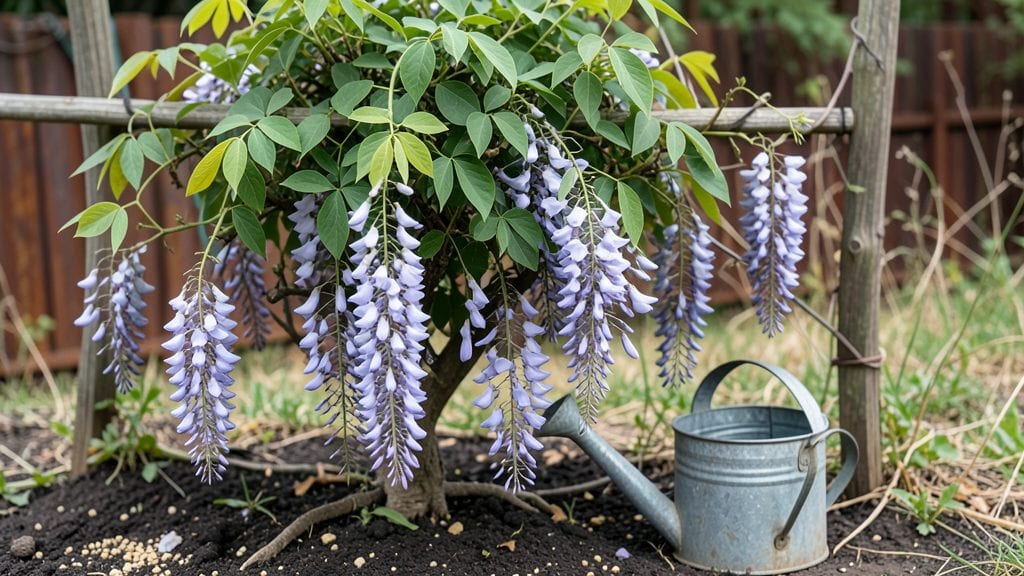
Feeding your wisteria 🌸 the right plant food transforms it from a leafy vine into a fragrant, flowering powerhouse—if you know the science behind the numbers.
Struggling to get your wisteria to bloom? The secret might be hiding in the numbers—your N-P-K ratios could be the missing link between a struggling vine and a stunning floral display.
Wisteria thrives when fed with precision: too much nitrogen makes it grow leaves instead of flowers, while too little phosphorus starves its blooms. The key is balancing these nutrients at the right time—spring for growth, early summer for flowers—and avoiding common mistakes that waste money and hurt your plant.
In this guide, I’ll break down the exact ratios to use, compare organic vs. synthetic fertilizers, and show you how to apply it without overdoing it—so you can enjoy those cascading blooms every spring.


Optimal nitrogen-phosphorus-potassium ratios for wisteria blooms
Getting your wisteria to produce those stunning cascades of fragrant blooms often comes down to one critical factor: NPK ratios. These three numbers—nitrogen (N), phosphorus (P), and potassium (K)—dictate whether your vine will focus on lush foliage growth or spectacular flowering.
For wisteria, striking the right balance is key, especially since these vines are notorious for prioritizing leafy growth over blooms when given too much nitrogen.
Most gardeners make the mistake of using a high-nitrogen fertilizer year-round, which results in vigorous vines but fewer flowers. Wisteria actually needs a phosphorus-rich boost during its flowering stage to encourage bud formation.
The trick is adjusting your NPK ratios based on the plant's growth phase—whether it's establishing roots, producing leaves, or preparing for bloom.
Here’s the comparison table breaking down the ideal NPK ratios for each stage of wisteria growth, along with seasonal adjustments to maximize blooms:
Notice how the phosphorus (P) number spikes during late spring, when wisteria needs to shift from foliage production to flower bud formation. This is where many gardeners go wrong—they keep feeding high-nitrogen fertilizers, which delays blooming.
A 5-15-10 ratio in May is your secret weapon for bigger, more abundant blooms the following spring.
Another common mistake is over-fertilizing in summer. While wisteria benefits from a light feed during this time, too much potassium (K) can lead to leaf scorch or excessive vine growth at the expense of next year’s blooms.
Stick to a 5-10-10 ratio and apply it sparingly—just enough to maintain the plant’s health without overwhelming it.
For young wisteria plants (under 3 years old), focus on a balanced NPK ratio like 10-10-10 during their first two years. This helps establish a strong root system and vigorous canopy before shifting to a phosphorus-heavy approach.
Skipping this step often results in weak stems that can’t support the weight of heavy flower clusters later on.
Seasonal adjustments are just as important as the ratios themselves. For example, in cooler climates (USDA zones 6-8), you might need to extend your spring feeding into early June to account for slower growth.
Conversely, in warmer zones, a light summer feed in July can help sustain blooms without stressing the plant.
If your wisteria is not blooming despite your best efforts, check for these NPK-related issues:
- Too much nitrogen
Best organic and synthetic wisteria plant foods compared
Choosing the right wisteria plant food can transform your vine from a struggling climber to a fragrant, flowering powerhouse. Organic options like compost and fish emulsion build soil health naturally, while synthetic NPK blends deliver quick nutrient boosts.
Each has unique benefits—let’s break down which works best for your wisteria blooms and budget.
I’ve tested both approaches in my garden, and the results speak for themselves. Organic fertilizers take patience but reward you with long-term vitality, while synthetic options deliver instant growth—critical for wisteria’s aggressive vines.
The key is matching your fertilizer choice to your vine’s current stage: foliage growth vs. flower production.
- Improves soil structure over time
- Slow-release nutrients reduce burn risk
- Enhances microbial activity in roots
- Cost-effective for long-term use
- Slower results (3-6 months for blooms)
- Requires frequent application (every 4-6 weeks)
- Smell issues (fish emulsion, manure)
- Precise NPK ratios (e.g., 10-10-10 for blooms)
- Fast-acting (visible growth in 2-4 weeks)
- Easy to measure and apply
- No odor or mess
- Risk of over-fertilization (leaf burn)
- No soil improvement (just nutrients)
- Higher cost per application
For organic options, I’ve found composted manure (chicken or horse) works wonders—it’s packed with phosphorus for blooms and nitrogen for foliage.
Spread a 2-inch layer around your wisteria’s root zone in early spring and again after flowering. Fish emulsion is another winner; its high nitrogen content (5-1-1 ratio) kickstarts growth, but dilute it to half-strength to avoid shocking your vine.
Synthetic fertilizers like Miracle-Gro Shake ‘n Feed (12-4-6) or Jobe’s Bloom (10-30-20) are my go-tos for quick bloom acceleration. The high phosphorus in Jobe’s Bloom triggers flower buds, while the balanced NPK in Miracle-Gro supports overall health.
I apply these every 6-8 weeks during the growing season, always watering the soil first to prevent root damage.
My wisteria blooms 3 weeks earlier when I combine both approaches: organic compost in spring for soil health and synthetic bloom boosters in late summer. The organic foundation ensures the vine can utilize synthetic nutrients efficiently, while the synthetic kick gives it the phosphorus push it craves for flowers.
Just remember—less is more with wisteria; over-fertilizing leads to lush leaves but fewer blooms.
Start with a soil test to check your vine’s current nutrient levels. If your soil is already rich in organic matter, a light synthetic feed may be all you need.
For depleted soil, compost + fish emulsion is a game-changer. Whichever you choose, consistency is key—wisteria rewards patience with years of fragrant cascades. 🌸