Companion Plants
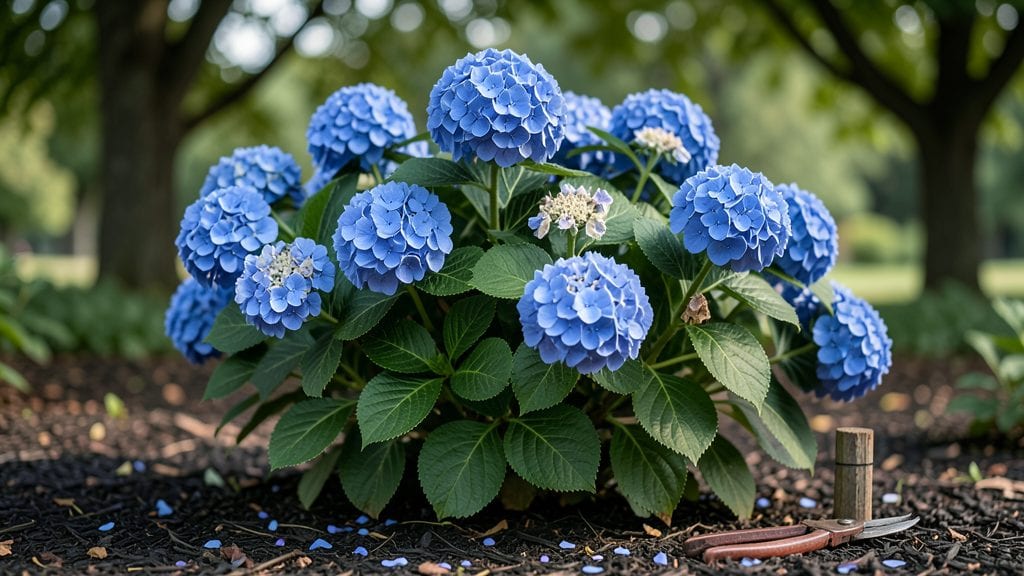
Rare hydrangea plants stand out with unique foliage colors like deep purple, silver, or variegated edges, alongside striking blooms in shades of blue, pink, or rare white with oversized petals. These cultivars often require specific soil pH and pruning techniques to thrive.
These standout hydrangeas often emerge from hybrid breeding programs or natural genetic mutations, creating foliage that ranges from metallic silver to deep burgundy. 🌿 For example, the 'Limelight' cultivar boasts chartreuse blooms that age to a soft pink, while 'Preziosa' features delicate lacecap flowers with a pale lavender hue.
Their rarity stems from both their stunning visual appeal and the meticulous care they demand—think precise pH levels (5.5-6.5 for blue blooms) and strategic pruning to encourage robust growth.
Their unique traits extend beyond color: some varieties, like 'Annabelle', develop massive white blooms that resemble pom-poms, while others, such as 'Endless Summer', produce flowers on both old and new wood.
These distinctions make them prized additions to gardens, but they also require patience—many rare hydrangeas take 2-3 years to establish their signature foliage and bloom patterns.
💡 In This Article
- Identifying Rare Hydrangea Leaf and Flower Variations
- Growing Conditions for Collectible Hydrangea Cultivars
Identifying rare hydrangea leaf and flower variations
Rare hydrangeas showcase extraordinary botanical traits that set them apart from common varieties. The foliage of Hydrangea macrophylla 'Nikko Blue' features deep, glossy leaves with a rich purple hue that develops as temperatures drop, a trait influenced by anthocyanin production triggered by cooler autumn weather.
Meanwhile, H. quercifolia 'Snow Queen' displays striking white bark with leaves that emerge bronze before maturing to a silvery-green, creating a dramatic contrast. These pigment variations occur due to genetic mutations affecting chlorophyll and anthocyanin pathways.
The bloom morphology of rare hydrangeas reveals even more distinctions. Lacecap varieties like 'Preziosa' produce flat-topped clusters with delicate, fertile florets in the center surrounded by showy, sterile ray flowers, creating a lace-like appearance.
In contrast, mophead types such as 'Annabelle' develop dense spherical blooms where all florets are sterile and uniform.
The size difference is striking too: while common hydrangeas average 4-6 inches in diameter, rare cultivars like 'Grandiflora' can reach 8-10 inches with individual blooms weighing up to 0.5 pounds when fully hydrated.
Genetic mutations play a crucial role in creating these rare traits. For instance, the white blooms of 'Annabelle' result from a recessive allele that suppresses anthocyanin production in the petals, while the variegated foliage of 'Limelight' stems from a chimeral mutation where cells with different pigmentation patterns coexist.
These mutations often occur spontaneously but can be stabilized through careful propagation techniques like grafting or tissue culture to maintain the desired traits across generations.
Leaf shape also varies dramatically between species. The oakleaf hydrangea (H. quercifolia) features lobed leaves resembling miniature oak foliage, while bigleaf varieties (H. macrophylla) produce broader, rounded leaves with serrated edges.
The texture differs too: oakleaf varieties develop a papery, exfoliating bark that adds winter interest, while bigleaf types maintain smooth stems. These physical characteristics aren't just decorative—they influence how each variety responds to environmental stressors like drought or temperature fluctuations.
What makes these variations particularly fascinating is how they interact with environmental factors. For example, the blue blooms of 'Nikko Blue' develop only when soil pH remains below 6.0, while pink versions require pH levels above 7.0.
This color-changing mechanism occurs through aluminum ion availability in acidic soils, which binds to anthocyanin pigments and shifts their light absorption properties. Understanding these interactions helps gardeners create ideal conditions for rare cultivars to express their full genetic potential.
When identifying rare hydrangeas, pay attention to these key distinguishing features: leaf shape and texture, bloom morphology (lacecap vs. mophead), pigmentation patterns, and growth habit. These traits not only make each variety visually unique but also provide clues about their care requirements and genetic origins. 🌸